
MechatronicsforU.com

Lets make machines

ESP32 Complete Chip Family — Full Comparison Guide 2026

Complete Field Guide

EVERY
ESP32
CHIP

ESP32 vs ESP32-S3 vs C3 vs C6: Full Specs & Buyer’s Guide

Ten chips. One family. Radical differences. From a 80-cent RISC-V node to a 400 MHz multimedia powerhouse — this is the only guide you need to pick the right Espressif chip for your next build.

Chips covered10
First release2016
Max CPU speed400MHz
Cheapest chip$0.80
Specs compared60+

01
Espressif Family

CHIP-BY-CHIP BREAKDOWN

“The original ESP32 is not the best ESP32 anymore — but it’s still the most useful one for most people. The trick is knowing which variant actually fits your project.”

MechatronicsForU — Build smarter, not harder

01
● 2016 · Xtensa LX6
ESP32
The original. Still the most popular.
Dual-core, Wi-Fi, Bluetooth Classic AND BLE 4.2. The only chip in the entire family with BT Classic — essential for A2DP audio and SPP serial. Largest community, most tutorials, best all-rounder.
Wi-Fi 4BT ClassicBLE 4.2Dual-Core
SRAM520 KB
CPU240 MHz
GPIO34 pins
Sleep~100 µA

// Best forGeneral IoT, home automation, BT audio (A2DP), ESP-NOW mesh, Arduino projects, audio streaming

02
● 2019 · Xtensa LX7
ESP32-S2
USB-native. 5× lower power sleep.
Dropped Bluetooth entirely to achieve 22 µA deep sleep — 5× better than the original. Gained native USB-OTG, making it perfect for USB HID devices without a UART bridge chip. CircuitPython’s favourite chip.
Wi-Fi 4USB-OTG22µA SleepNo Bluetooth
SRAM320 KB
CPU240 MHz
GPIO43 pins
Sleep~22 µA

// Best forUSB HID gadgets, battery devices, CircuitPython dev boards, USB cameras, low-power Wi-Fi sensors

03
● 2020 · Xtensa LX7 Dual
ESP32-S3
AI acceleration. The maker’s flagship.
The power upgrade of the family. Dual LX7 cores with vector/SIMD instructions for TFLite Micro edge AI. Native USB-OTG, BLE 5.0, DVP camera interface, 512 KB SRAM + up to 8 MB PSRAM. The go-to for smart cameras.
AI/MLBLE 5.0USB-OTGCamera
SRAM512 KB
CPU240 MHz
GPIO45 pins
Sleep~8 µA

// Best forEdge AI, face detection, TFLite Micro, smart cameras, USB gadgets, rich displays, voice recognition

04
● 2022 · RISC-V RV32IMC
ESP32-C2
Cheapest chip. ~$0.80 in volume.
Espressif’s budget champion. Wi-Fi 4 + BLE 5.0 in a tiny 4×4 mm QFN package for under a dollar. 272 KB SRAM, 14 GPIOs. Stripped to absolute essentials — use when cost is the primary constraint.
Wi-Fi 4BLE 5.0~$0.804×4 mm
SRAM272 KB
CPU120 MHz
GPIO14 pins
Sleep~5 µA

// Best forUltra-budget production nodes, cost-sensitive commercial IoT, simple Wi-Fi sensors, Matter end devices

05
● 2020 · RISC-V RV32IMC
ESP32-C3
The RISC-V sweet spot.
Wi-Fi 4 + BLE 5.0 + Secure Boot + Matter support — all for ~$1.20. 400 KB SRAM, ~5 µA deep sleep. The practical upgrade from the old ESP8266. Large community, Zephyr RTOS support, broadly available.
Wi-Fi 4BLE 5.0~5µA SleepMatter
SRAM400 KB
CPU160 MHz
GPIO22 pins
Sleep~5 µA

// Best forBudget Wi-Fi+BLE nodes, battery sensors, MicroPython, ESP-NOW mesh, Zephyr RTOS projects

06
● 2022 · RISC-V Dual-Core
ESP32-C6
Wi-Fi 6 + Thread + Zigbee. Smart home king.
First ESP chip with Wi-Fi 6 (802.11ax). Also packs BLE 5.3, Thread, and Zigbee — all in one die. Full Matter protocol stack. The definitive chip for modern smart home product development.
Wi-Fi 6ThreadZigbeeMatter
SRAM512 KB
CPU160 MHz
GPIO30 pins
Sleep~7 µA

// Best forMatter devices, smart home hubs, Thread border routers, Zigbee coordinators, Wi-Fi 6 nodes

07
● 2023 · RISC-V RV32IMAC
ESP32-H2
No Wi-Fi. Pure mesh specialist.
Deliberately stripped of Wi-Fi to maximize mesh efficiency. Pure 802.15.4 + BLE 5.3 for Thread leaf nodes and Zigbee end devices. The best range-per-milliwatt chip in the entire family.
No Wi-FiThreadZigbeeBLE 5.3
SRAM256 KB
CPU96 MHz
GPIO26 pins
Sleep~7 µA

// Best forZigbee end devices, Thread leaf nodes, ultra-low-power mesh sensors, Matter over Thread

08
● 2024 · RISC-V RV32IMAFC
ESP32-P4
400 MHz. No wireless. Raw power king.
Espressif’s most powerful chip ever. 400 MHz dual-core, H.264 hardware video encode/decode, MIPI-DSI display and MIPI-CSI camera interfaces, 768 KB SRAM. No Wi-Fi or BT — pairs with a C6. Still early release.
400 MHzH.264MIPI-DSI/CSINo Wireless
SRAM768 KB
CPU400 MHz
GPIO54 pins
Sleep~20 µA

// Best forRich HMI displays, H.264 video processing, industrial panels, high-speed data, multimedia hubs

1B
Most Popular Modules — Deep Dive

ESP32-S3 WROOM · S3 MINI · C3 MINI · C6 MINI

“The MINI modules are where Espressif really nailed the balance between size, price, and capability. These three in particular dominate most new IoT product designs in 2024–2026.”

MechatronicsForU — Field Engineering Notes

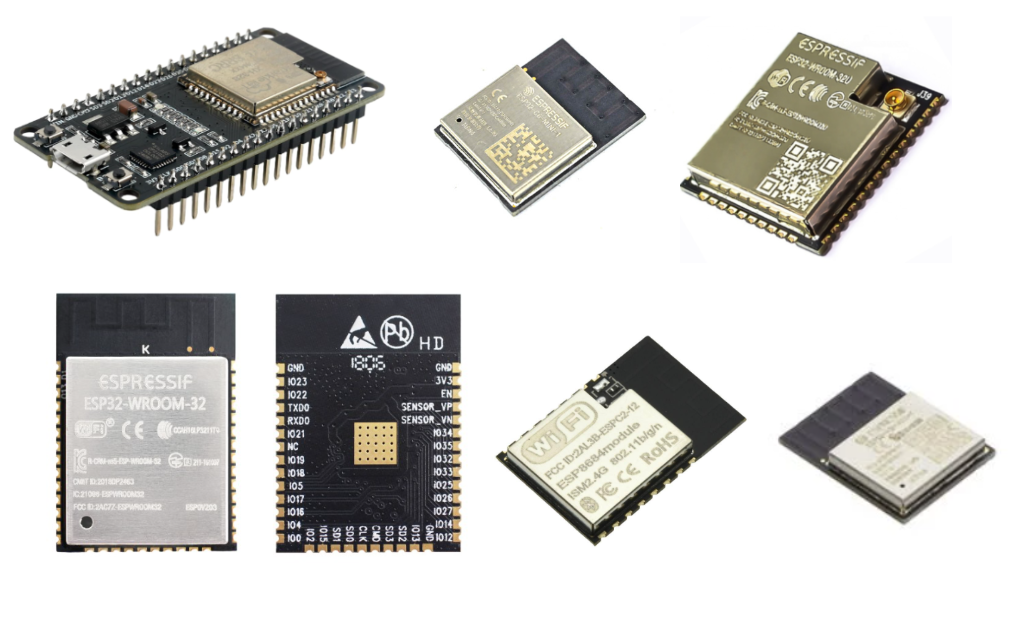
ESP32-S3-WROOM-1

Module · Dual-core 240 MHz · AI Acceleration · Wi-Fi 4 + BLE 5.0 · USB-OTG

// What makes it special

The ESP32-S3-WROOM-1 is the most capable pre-certified module Espressif makes. At its core is the ESP32-S3 SoC — Espressif’s first chip with vector instructions (PIE extensions) designed specifically for AI and DSP workloads. This makes it capable of running TFLite Micro models, wake-word detection engines, and image classification pipelines that would be impossible on the original ESP32.

The module comes in multiple flash/PSRAM variants — the N4 (4MB flash) for basic use, all the way to the flagship N16R8 (16MB flash + 8MB PSRAM) used in AI camera projects. The 8MB PSRAM is critical — it gives you enough RAM to buffer camera frames, run ML inference, and maintain a Wi-Fi connection simultaneously.

Native USB-OTG means it can appear as a USB HID device, CDC serial device, or MSC storage device — without any additional chip. Combined with the 45 GPIO pins (most in the family), it’s the go-to for complex maker projects and commercial products alike.

// Full Module Specifications

SoC ESP32-S3
CPU Dual Xtensa LX7 @ 240 MHz
Internal SRAM 512 KB
Flash Options 4 / 8 / 16 MB
PSRAM Options None / 2 MB / 8 MB
Wi-Fi 802.11b/g/n (Wi-Fi 4), 2.4 GHz
Bluetooth BLE 5.0 + BT Mesh
USB USB-OTG 1.1 Full Speed
GPIO Pins 45 programmable
ADC 20 channels, 12-bit
Touch Sensors 14 capacitive
Camera (DVP) Yes — up to OV2640
Deep Sleep ~8 µA
Module Size 18 × 25.5 × 3.1 mm
Antenna PCB trace (WROOM-1) / U.FL (WROOM-1U)
Certifications CE / FCC / TELEC / KCC
Est. Module Price ~$4–8 (N4) / ~$6–10 (N16R8)

// Ideal Use Cases

  • AI camera with OV2640 / OV5640
  • Face detection & recognition
  • Voice wake-word detection
  • TFLite Micro inference
  • USB HID (keyboard, gamepad)
  • Smart displays with LVGL
  • Wi-Fi + BLE dual mode apps
  • CircuitPython / MicroPython

// SDK & Framework Support

  • ESP-IDF v5.x (full support)
  • Arduino IDE (ESP32 core v2+)
  • MicroPython v1.22+
  • CircuitPython 9+
  • Zephyr RTOS
  • ESP-WHO (AI vision framework)
  • ESP-SR (speech recognition)
  • ESPHome (limited)

// DigiKey Part Numbers

  • ESP32-S3-WROOM-1-N4
  • ESP32-S3-WROOM-1-N8
  • ESP32-S3-WROOM-1-N16R8
  • ESP32-S3-WROOM-1U-N4
  • ESP32-S3-WROOM-1U-N16R8
  • ESP32-S3-WROOM-2-N32R8V ⚠ Obsolete

ESP32-S3-MINI-1

Module · Dual-core 240 MHz · AI Acceleration · Wi-Fi 4 + BLE 5.0 · Smallest S3 Package

PCB
ANT

MINI-1 — On-board PCB Antenna

15.4 × 20.5 × 2.4 mm

Antenna built into PCB — no external connector needed. Best RF performance in open air.

U.FL
ANT

MINI-1U — External U.FL Connector

15.4 × 15.4 × 2.4 mm

5mm shorter — no PCB antenna stub. Needs external antenna via U.FL cable. Better for enclosed metal cases.

// Key difference vs WROOM-1
The ESP32-S3-MINI-1 uses the same ESP32-S3 SoC as the WROOM-1 — same dual-core 240 MHz, same AI vector instructions, same BLE 5.0 and Wi-Fi 4. The difference is physical size and flash/PSRAM options. The MINI-1 is 2.8 mm shorter and 5 mm narrower than the WROOM-1, making it ideal for space-constrained PCB designs. The trade-off: fewer PSRAM options (max 8MB PSRAM on N8R8 variant) and slightly fewer exposed GPIO pads compared to WROOM-1.

// What makes it special

The MINI-1 gives you the full power of the ESP32-S3 — AI vector instructions, dual LX7 cores, USB-OTG, BLE 5.0 — but in a 15.4 × 20.5 mm footprint, making it the smallest ESP32-S3 pre-certified module available.

This size reduction matters enormously in wearables, compact smart devices, and any project where PCB real estate is limited. The MINI-1 uses a LGA (Land Grid Array) pad layout instead of the through-hole castellated pads of the WROOM — this means it’s only suitable for reflow soldering (not hand-soldering), making it more of a production module than a prototyping module.

The MINI-1 is available in three main variants: N4R2 (4MB flash + 2MB PSRAM — perfect for most embedded AI projects), N8R8 (8MB flash + 8MB PSRAM — for image processing and large model inference), and N4 (4MB flash only — no PSRAM, for simple Wi-Fi+BLE tasks where AI is not required).

Like the WROOM-1, it supports the full ESP-WHO computer vision framework and ESP-SR speech recognition stack. The USB-OTG port enables direct programming without a UART bridge, and the 27 exposed GPIO pads cover all common peripheral needs — I2C, SPI, UART, I2S, PWM, ADC.

// Full Module Specifications

SoC ESP32-S3
CPU Dual Xtensa LX7 @ 240 MHz
AI Instructions Yes — PIE vector extensions
Internal SRAM 512 KB
Flash Options 4 MB (N4) / 8 MB (N8)
PSRAM Options None / 2 MB (R2) / 8 MB (R8)
Wi-Fi 802.11b/g/n (Wi-Fi 4), 2.4 GHz
Bluetooth BLE 5.0 + BT Mesh
USB USB-OTG 1.1 Full Speed
Exposed GPIO 27 pads (LGA footprint)
ADC 20 channels, 12-bit
Touch Sensors 14 capacitive
Camera (DVP) Yes — up to OV2640
Deep Sleep ~8 µA
Module Size MINI-1: 15.4 × 20.5 × 2.4 mm
Module Size (U) MINI-1U: 15.4 × 15.4 × 2.4 mm
Pad Type LGA — reflow only (no hand solder)
Antenna (MINI-1) On-board PCB trace
Antenna (MINI-1U) External U.FL connector
Est. Module Price ~$3–6 (N4) / ~$5–9 (N8R8)

// WROOM-1 vs MINI-1 — When to choose which

Size priority MINI-1 ✓
Max PSRAM (16MB) WROOM-1 ✓
Hand-solderable WROOM-1 ✓
Most GPIO exposed WROOM-1 ✓
Production PCB MINI-1 ✓
Wearable / compact MINI-1 ✓

// Ideal Use Cases

  • Compact AI camera modules
  • Wearable health monitors
  • Smart glasses / HMD devices
  • Drone / robot controllers
  • Voice assistant endpoints
  • Production PCBs (reflow)
  • Compact smart displays
  • TFLite Micro + Wi-Fi combo

// DigiKey Part Numbers

  • ESP32-S3-MINI-1-N4
  • ESP32-S3-MINI-1-N4R2
  • ESP32-S3-MINI-1-N8R8
  • ESP32-S3-MINI-1U-N4
  • ESP32-S3-MINI-1U-N4R2
  • U = U.FL antenna · R2/R8 = PSRAM

ESP32-C3-MINI-1

Module · Single-core RISC-V 160 MHz · Wi-Fi 4 + BLE 5.0 · Secure Boot · Ultra-Compact

// What makes it special

The ESP32-C3-MINI-1 is Espressif’s answer to the question: “What if you could build a Wi-Fi + BLE product in the smallest possible footprint without sacrificing security?”

At just 13.2 × 16.6 mm, this is one of the most compact certified Wi-Fi+BLE modules available anywhere. It uses the ESP32-C3 SoC — a RISC-V single-core running at 160 MHz — making it the first ESP module built on an open-source ISA. This matters because RISC-V toolchains are increasingly preferred in commercial embedded development.

What really sets the C3 MINI apart is its security story. It ships with RSA-3072 based Secure Boot v2, AES-128-XTS flash encryption, digital signature peripheral, and HMAC-based device identity — security features that used to require expensive dedicated secure elements. Combined with native Matter protocol support, it’s become a default choice for mass-production smart home accessories.

The module also has a built-in USB Serial/JTAG peripheral — you can flash and debug it over USB without any external programmer, just a data USB cable.

// Full Module Specifications

SoC ESP32-C3
CPU Single RISC-V @ 160 MHz
Architecture RISC-V RV32IMC (open ISA)
Internal SRAM 400 KB
Flash 4 MB embedded
Wi-Fi 802.11b/g/n (Wi-Fi 4), 2.4 GHz
Bluetooth BLE 5.0 + Long Range
USB USB Serial/JTAG (built-in)
GPIO Pins 22 programmable
ADC 6 channels, 12-bit SAR
Secure Boot v2 (RSA-3072)
Flash Encryption AES-128-XTS
Matter Support Yes (Wi-Fi + BLE provisioning)
Deep Sleep ~5 µA
Module Size 13.2 × 16.6 × 2.4 mm
Antenna PCB trace (MINI-1) / U.FL (MINI-1U)
Est. Module Price ~$2–5

// Ideal Use Cases

  • Battery-powered BLE sensors
  • Smart plugs & switches
  • Matter end-devices
  • ESP-NOW sensor networks
  • MicroPython IoT projects
  • Low-cost Wi-Fi + BLE combo
  • Wearable IoT devices
  • Industrial sensor nodes

// Compared to ESP8266

CPU Speed 2× faster (160 vs 80 MHz)
SRAM 10× more (400 vs 36 KB)
Bluetooth BLE 5.0 (none on 8266)
Security Secure Boot v2
Price diff Only ~$0.50 more

// DigiKey Part Numbers

  • ESP32-C3-MINI-1-N4
  • ESP32-C3-MINI-1U-N4
  • ESP32-C3FH4 (bare SoC)
  • N4 = 4MB flash embedded
    U = U.FL external antenna

ESP32-C6-MINI-1

Module · Dual-core RISC-V 160 MHz · Wi-Fi 6 + BLE 5.3 + Thread + Zigbee · Full Matter Stack

// What makes it special

The ESP32-C6-MINI-1 is the most feature-packed small module Espressif has ever released. In a compact 21 × 18 mm footprint it combines four completely different radio technologies: Wi-Fi 6 (802.11ax), Bluetooth LE 5.3, IEEE 802.15.4 for Thread, and Zigbee. No other module at this price point comes close.

Wi-Fi 6 (802.11ax) is the headline feature. Compared to Wi-Fi 4 (802.11n), Wi-Fi 6 brings OFDMA (multiple devices share one channel more efficiently), TWT (Target Wake Time — devices sleep longer and wake on schedule, massively improving battery life in dense deployments), and BSS Coloring (reduces interference in crowded environments like apartment buildings or factories). For IoT, this isn’t about raw speed — it’s about coexistence and battery efficiency.

The dual RISC-V architecture is also unique: a 160 MHz HP core handles the main application while a 20 MHz LP (Low Power) core stays awake during sleep modes to monitor peripherals — all without waking the main CPU. This dramatically reduces average power in event-driven applications.

With a full Matter over Wi-Fi and Matter over Thread stack, the C6-MINI-1 is the reference module for smart home products targeting Apple Home, Google Home, Amazon Alexa, and Samsung SmartThings simultaneously.

// Full Module Specifications

SoC ESP32-C6
CPU Dual RISC-V: 160 MHz HP + 20 MHz LP
Internal SRAM 512 KB
RTC SRAM 32 KB (largest in family)
Flash 4 MB embedded
Wi-Fi Wi-Fi 6 (802.11ax) — 2.4 GHz
Bluetooth BLE 5.3 + Long Range + Mesh
IEEE 802.15.4 Thread + Zigbee
Matter Full stack — Wi-Fi + Thread
GPIO Pins 30 programmable
USB USB Serial/JTAG
Secure Boot v2 + Digital Signature
Deep Sleep ~7 µA (LP core active)
Module Size 21 × 18 × 3.2 mm
Antenna PCB trace (MINI-1) / U.FL (MINI-1U)
Est. Module Price ~$4–8

// Ideal Use Cases

  • Matter smart plugs & lights
  • Thread border router
  • Zigbee coordinator/router
  • Wi-Fi 6 sensor nodes
  • Apple Home / Google Home devices
  • Battery + Wi-Fi TWT devices
  • Smart home gateway
  • Industrial mesh networks

// Wi-Fi 6 vs Wi-Fi 4 (for IoT)

OFDMA Shared channel slots
TWT Sleep Scheduled wake = less power
BSS Color Less interference in crowds
Dense deploy 50+ devices per AP
Backward compat Works on Wi-Fi 4 routers

// DigiKey Part Numbers

  • ESP32-C6-MINI-1-N4
  • ESP32-C6-MINI-1U-N4
  • N4 = 4MB flash embedded
    U = U.FL external antenna
    Works with ESP-IDF v5.1+

02
All Variants Side-By-Side

FULL SPECIFICATION TABLE

How to read this table: Green = YES or best-in-class. Grey = No / not applicable. Red = best-in-family winner. Scroll right on mobile.

Specification ESP32 ESP32-S2 ESP32-S3 ESP32-C2 ESP32-C3 ESP32-C6 ESP32-H2 ESP32-P4
IDENTITY
Release Year 2016 2019 2020 2022 2020 2022 2023 2024
Architecture Xtensa LX6 Xtensa LX7 Xtensa LX7 RISC-V RISC-V RISC-V RISC-V RISC-V
CPU
CPU Cores Dual (2) Single Dual (2) Single Single Dual (2) Single Dual (2)
Max Frequency 240 MHz 240 MHz 240 MHz 120 MHz 160 MHz 160 MHz 96 MHz 400 MHz ★
AI / Vector Instructions YES (PIE) YES
FPU (Floating Point) YES YES
MEMORY
Internal SRAM 520 KB 320 KB 512 KB 272 KB 400 KB 512 KB 256 KB 768 KB ★
External Flash Up to 16 MB Up to 1 GB Up to 1 GB 4 MB 4 MB 32 MB 4 MB 32 MB
PSRAM Support Via SPI Up to 128 MB Up to 32 MB Via SPI Up to 32 MB
WIRELESS
Wi-Fi Standard Wi-Fi 4 Wi-Fi 4 Wi-Fi 4 Wi-Fi 4 Wi-Fi 4 Wi-Fi 6 ★ None None
Bluetooth Classic YES ★ Only One
Bluetooth LE BLE 4.2 None BLE 5.0 BLE 5.0 BLE 5.0 BLE 5.3 BLE 5.3 None
Thread / Zigbee YES ★ YES
Matter Protocol Partial Partial Partial YES ★ YES
GPIO & PERIPHERALS
Total GPIO Pins 34 43 45 ★ 14 22 30 26 54 ★
DAC Channels 2 ch 2 ch YES
Touch Sensors 10 14 14 YES
Native USB USB-OTG 1.1 USB-OTG 1.1 USB Serial USB Serial USB Serial USB 2.0 HS ★
Camera Interface DVP DVP ★ MIPI-CSI ★
Ethernet MAC YES GMAC
POWER
Deep Sleep Current ~100 µA ~22 µA ~8 µA ~5 µA ★ ~5 µA ★ ~7 µA ~7 µA ~20 µA
Supply Voltage 2.3–3.6 V 3.0–3.6 V 3.0–3.6 V 3.0–3.6 V 3.3 V typ 3.0–3.6 V 3.0–3.6 V 3.3–5 V
PRICING
Est. Chip Unit Price ~$2.00 ~$1.50 ~$2.00 ~$0.80 ★ ~$1.20 ~$2.00 ~$1.80 ~$3.50
Est. Module Price ~$3–6 ~$4–8 ~$4–8 ~$2–4 ~$2–5 ~$4–8 ~$3–6 N/A

03
Protocol Support

WIRELESS MATRIX

Protocol / Standard ESP32 S2 S3 C2 C3 C6 H2 P4
WI-FI
Wi-Fi 4 (802.11b/g/n)
Wi-Fi 6 (802.11ax 2.4GHz) ★ ONLY
BLUETOOTH
Bluetooth Classic (A2DP/SPP) ★ ONLY
BLE 4.2
BLE 5.0
BLE 5.3 + Long Range
MESH / 802.15.4
Thread Protocol
Zigbee Protocol
Matter (Full Stack) ★ Best
OTHER
ESP-NOW (Espressif mesh)
Native USB (OTG / HS) OTG 1.1 OTG 1.1 USB 2.0 HS
Ethernet MAC GMAC

04
Decision Guide

PROJECT PICKER

“The worst mistake in embedded design is picking a chip based on what’s familiar rather than what fits. These cards will save you that mistake.”

MechatronicsForU — Embedded Systems Guides

// General IoT / Starting out
ESP32 Original
Largest ecosystem, most tutorials, Wi-Fi + BT Classic + BLE, dual-core, mature libraries. Thousands of Arduino projects available. Best starting point, period.
// Avoid ifYou need ultra-low power or BLE 5.0

// Battery / Ultra-Low Power
ESP32-C3
~5 µA deep sleep with Wi-Fi 4 + BLE 5.0. Secure Boot, Matter ready, RISC-V architecture. Best balance of features vs power consumption in the family.
// Avoid ifNeed BT Classic or heavy compute

// AI / Machine Learning Edge
ESP32-S3
Vector SIMD instructions, dual-core 240 MHz, 512 KB SRAM, TFLite Micro support. Only Wi-Fi+BLE chip in the family with true ML hardware acceleration.
// Avoid ifSimple sensor node (overkill + cost)

// Smart Home / Matter
ESP32-C6
Wi-Fi 6 + BLE 5.3 + Thread + Zigbee in one chip. Full Matter stack, 32 KB RTC SRAM. The definitive chip for new smart home product development.
// Avoid ifNeed BT Classic or high compute

// Camera / Vision
ESP32-S3
DVP camera interface, PSRAM for frame buffers, dual-core 240 MHz for concurrent Wi-Fi + camera. Used in all popular AI cam boards (AI-Thinker, Freenove).
// Avoid ifNeed 4K / MIPI — use P4 + C6 combo

// Zigbee / Thread Mesh
ESP32-H2
Dedicated 802.15.4 + BLE 5.3. No Wi-Fi = maximum mesh efficiency. Best range-per-mW in the family. Perfect Zigbee end device and Thread leaf node.
// Avoid ifWi-Fi required on same chip

// BT Classic Audio (A2DP)
ESP32 Original — Only Option
The ONLY chip in the entire ESP32 family with Bluetooth Classic. Required for A2DP audio streaming, SPP serial ports, RFCOMM profiles. No substitute.
// No alternativein the ESP32 family

// Budget / Cost-Critical
ESP32-C2
Cheapest Wi-Fi+BLE chip at ~$0.80 in volume. 4×4 mm QFN, 120 MHz RISC-V, ~5 µA sleep. Use when every rupee counts and peripherals are minimal.
// Avoid ifNeed many GPIOs, DAC, or touch

// USB Device (HID / MIDI)
ESP32-S2 or S3
Both have native USB-OTG 1.1 — no USB-to-serial chip needed. S3 adds BLE + dual-core if wireless and USB are both needed simultaneously.
// Avoid ifNeed BT Classic

// Max Performance / HMI
ESP32-P4
400 MHz dual-core, H.264 video, MIPI-DSI display, 768 KB SRAM. Fastest ESP chip ever. Pair with C6 for wireless. Still early release — check availability.
// Avoid ifBuilt-in Wi-Fi/BT required

05
DigiKey RF Transceiver Modules Cat. 872

MODULE REFERENCE

These modules are pre-certified, antenna-integrated, and ready to drop into your PCB. They save certification time — critical for commercial products. Data sourced from DigiKey India, Espressif datasheets.

Module (DigiKey Part) Base Chip Wi-Fi Bluetooth Flash PSRAM Antenna Type Module Size Notes
▶ ESP32 — WROOM / WROVER / MINI
ESP32-WROOM-32E-N4 ESP32 Wi-Fi 4 BT4.2 + BLE 4 MB PCB Trace 18×25.5×3.1 mm Standard, most common
ESP32-WROOM-32E-N8 ESP32 Wi-Fi 4 BT4.2 + BLE 8 MB PCB Trace 18×25.5×3.1 mm 8 MB flash variant
ESP32-WROOM-32E-N16 ESP32 Wi-Fi 4 BT4.2 + BLE 16 MB PCB Trace 18×25.5×3.1 mm Max flash WROOM
ESP32-WROOM-32UE-N4 ESP32 Wi-Fi 4 BT4.2 + BLE 4 MB U.FL External 18×19.2×3.1 mm 6.3 mm shorter, ext. antenna
ESP32-WROVER-E (N4R8) ESP32 Wi-Fi 4 BT4.2 + BLE 4 MB 8 MB PCB Trace 18×31.4×3.3 mm 8 MB PSRAM, larger body
ESP32-WROVER-IE (N4R8) ESP32 Wi-Fi 4 BT4.2 + BLE 4 MB 8 MB U.FL External 18×25.5×3.3 mm PSRAM + external antenna
ESP32-MINI-1-N4 ESP32 Wi-Fi 4 BT4.2 + BLE 4 MB PCB Trace 13.2×16.6×2.4 mm Smallest ESP32 classic module
ESP32-MINI-1U-N4 ESP32 Wi-Fi 4 BT4.2 + BLE 4 MB U.FL External 13.2×12.1×2.4 mm Ultra-compact with ext. antenna
▶ ESP32-S2 — WROOM / WROVER
ESP32-S2-WROOM ESP32-S2 Wi-Fi 4 None 4 MB PCB Trace 18×25.5×3.1 mm No BT, USB-OTG native
ESP32-S2-WROOM-I ESP32-S2 Wi-Fi 4 None 4 MB U.FL External 18×19.2×3.1 mm U.FL, no BT, USB-OTG
ESP32-S2-WROVER ESP32-S2 Wi-Fi 4 None 4 MB 2 MB PCB Trace 18×31.4×3.3 mm 2 MB PSRAM, PCB antenna
ESP32-S2-WROVER-I ESP32-S2 Wi-Fi 4 None 4 MB 2 MB U.FL External 18×25.5×3.3 mm 2 MB PSRAM + ext. antenna
▶ ESP32-S3 — WROOM-1 / WROOM-2 / MINI-1
ESP32-S3-WROOM-1-N4 ESP32-S3 Wi-Fi 4 BLE 5.0 4 MB PCB Trace 18×25.5×3.1 mm Entry S3 module
ESP32-S3-WROOM-1-N8 ESP32-S3 Wi-Fi 4 BLE 5.0 8 MB PCB Trace 18×25.5×3.1 mm 8 MB flash, no PSRAM
ESP32-S3-WROOM-1-N16R8 ESP32-S3 Wi-Fi 4 BLE 5.0 16 MB 8 MB PCB Trace 18×25.5×3.1 mm Flagship — AI cam builds
ESP32-S3-WROOM-1U-N4 ESP32-S3 Wi-Fi 4 BLE 5.0 4 MB U.FL External 18×19.2×3.1 mm U.FL, 6.3 mm shorter
ESP32-S3-WROOM-1U-N16R8 ESP32-S3 Wi-Fi 4 BLE 5.0 16 MB 8 MB U.FL External 18×19.2×3.1 mm Max spec + ext. antenna
ESP32-S3-WROOM-2-N32R8V ESP32-S3 Wi-Fi 4 BLE 5.0 32 MB 8 MB OBSOLETE 18×25.5×3.1 mm Discontinued — see WROOM-1
ESP32-S3-MINI-1-N4 ESP32-S3 Wi-Fi 4 BLE 5.0 4 MB PCB Trace 15.4×20.5×2.4 mm Compact S3, LGA pads
ESP32-S3-MINI-1-N4R2 ESP32-S3 Wi-Fi 4 BLE 5.0 4 MB 2 MB PCB Trace 15.4×20.5×2.4 mm 2 MB PSRAM, compact
ESP32-S3-MINI-1-N8R8 ESP32-S3 Wi-Fi 4 BLE 5.0 8 MB 8 MB PCB Trace 15.4×20.5×2.4 mm Max PSRAM MINI
ESP32-S3-MINI-1U-N4 ESP32-S3 Wi-Fi 4 BLE 5.0 4 MB U.FL External 15.4×15.4×2.4 mm Smallest S3 module overall
ESP32-S3-MINI-1U-N4R2 ESP32-S3 Wi-Fi 4 BLE 5.0 4 MB 2 MB U.FL External 15.4×15.4×2.4 mm PSRAM + U.FL ultra-compact
▶ ESP32-C3 — MINI-1
ESP32-C3-MINI-1-N4 ESP32-C3 Wi-Fi 4 BLE 5.0 4 MB PCB Trace 13.2×16.6×2.4 mm Standard C3 MINI
ESP32-C3-MINI-1U-N4 ESP32-C3 Wi-Fi 4 BLE 5.0 4 MB U.FL External 13.2×11.6×2.4 mm U.FL, shorter body
ESP32-C3FH4 (bare SoC) ESP32-C3 Wi-Fi 4 BLE 5.0 4 MB int. None (bare chip) QFN-32 (5×5 mm) No module, no antenna
▶ ESP32-C6 — MINI-1
ESP32-C6-MINI-1-N4 ESP32-C6 Wi-Fi 6 BLE 5.3 4 MB PCB Trace 21×18×3.2 mm Wi-Fi 6 + Thread + Zigbee
ESP32-C6-MINI-1U-N4 ESP32-C6 Wi-Fi 6 BLE 5.3 4 MB U.FL External 21×13×3.2 mm U.FL, 5 mm shorter body
▶ ESP32-H2 — MINI-1
ESP32-H2-MINI-1-H4 ESP32-H2 No Wi-Fi BLE 5.3 4 MB PCB Trace 13.2×16.6×2.4 mm Thread + Zigbee only
ESP32-H2-MINI-1U-H4 ESP32-H2 No Wi-Fi BLE 5.3 4 MB U.FL External 13.2×11.6×2.4 mm Mesh node + ext. antenna
// Naming convention key
N4 = 4 MB flash  · 
N8 = 8 MB flash  · 
N16 = 16 MB flash  · 
N32 = 32 MB flash  · 
R2 = 2 MB PSRAM  · 
R8 = 8 MB PSRAM  · 
U suffix = U.FL external antenna connector  · 
I suffix = IPEX antenna connector  · 
LGA pads = reflow soldering only (MINI-1 S3)

06
Bottom Line

FINAL VERDICT

// Need BT Classic?
ESP32 Original
The only chip in the family. Non-negotiable for A2DP audio, SPP serial, RFCOMM profiles.

// Need AI / Camera?
ESP32-S3
Vector instructions, dual-core, PSRAM, DVP camera. The maker flagship for visual AI.

// Building for Matter?
ESP32-C6
Wi-Fi 6 + BLE 5.3 + Thread + Zigbee. Full Matter stack out of the box.

// Zigbee mesh nodes?
ESP32-H2
Dedicated 802.15.4, no Wi-Fi overhead. Best range efficiency in the family.

// Budget / High Volume?
ESP32-C2
~$0.80 with Wi-Fi + BLE. Smallest package. No frills, no excuses.

// Max Performance?
ESP32-P4
400 MHz, H.264 video, MIPI interfaces. Fastest ESP ever — no wireless though.

// Note on availability

The ESP32-P4 and ESP32-C5 remain in limited/preview availability as of mid-2026. Always verify stock on DigiKey or Mouser before designing them into production. Prices are approximate and fluctuate with supply. Verify all specs against the official Espressif datasheet for your specific chip revision.


SVK

Website: http://mechatronicsforu.com

One comment
ExoWatts

Great content! Keep up the good work!

Leave a Reply

Your email address will not be published. Required fields are marked *